Dear friend, the following is our monthly market report update, for your reference.
Market Overview:The tinplate market remains under pressure, with prices declining, inventory consumption slowing, and profit margins being squeezed across the supply chain. Weak demand and export pressure are weighing on market sentiment. The market is expected to remain in a weak and fluctuating adjustment phase in the near term.
1.Tinplate Prices
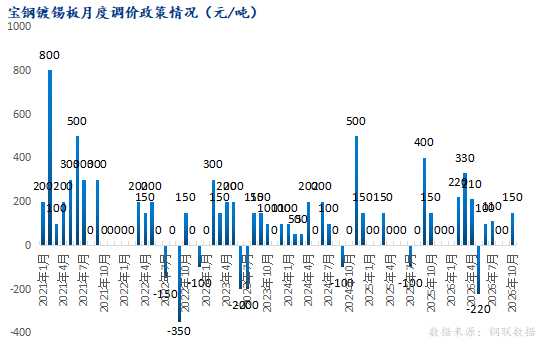
BaoSteel, WISCO, ShouGang and MeiSteel have maintained their existing offers for both tinplate and tin-free steel (TFS).
Other manufacturers have generally kept prices unchanged or reduced them slightly by RMB 20–50 per tonne.
2. Factors Affecting Tinplate Prices
2.1 Tin Ingot Prices
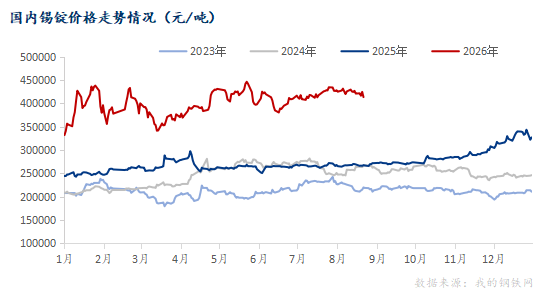
Lower tin ingot prices have reduced production costs. This is expected to have an impact equivalent to approximately RMB 140 per tonne on tinplate prices.
2.2 Hot-Rolled Steel Prices
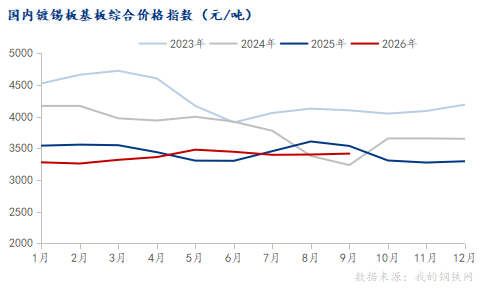
Hot-rolled steel prices continued to edge down, falling by RMB 10–60 per tonne. Overall market conditions remain weak.
2.3 Market Monitoring
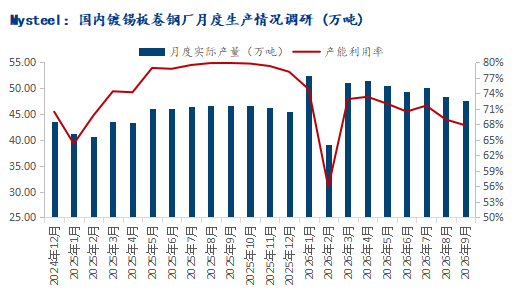
According to Mysteel’s survey of 30 domestic tinplate manufacturers, the operating rate reached 83% in October 2026, while capacity utilization stood at 68.19%.
Actual tinplate production totaled 478,000 tonnes, an increase of 2,500 tonnes month-on-month. Inventory held by the surveyed mills reached 215,500 tonnes, up 12,000 tonnes from the previous month.
In addition, Mysteel’s survey of major domestic chromium-coated steel manufacturers showed that October production totaled 140,800 tonnes, down 1,400 tonnes month-on-month.
3. Upstream and Downstream Market Data
3.1 Tinplate and Chromium-Coated Steel Exports
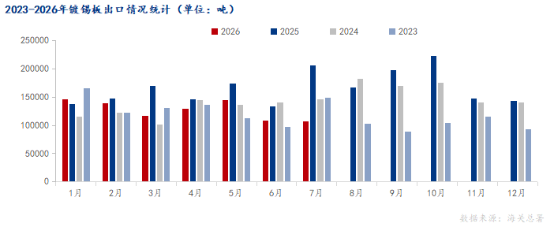
In September 2026, China exported 127,100 tonnes of tinplate, down 35.68% year-on-year. January–September exports totaled 1.1265 million tonnes, down 23.75%. Chromium-coated steel exports reached 53,200 tonnes in September, up 19.17%, while the January–September total was 375,900 tonnes, down 12.71%. Overall, tinplate exports in 2026 have fallen short of expectations, and new export orders in the fourth quarter have been relatively subdued.
3.2 U.S. Steel Imports
U.S. steel import license applications totaled 2.214 million short tons in October, down 11% from September. Finished steel applications reached 1.719 million short tons, 3% above September’s final import volume. Tinplate import applications increased by 42% compared with September’s final imports. South Korea remained the largest source, while imports from Vietnam rose 119% to 213,000 short tons.
3.3 South Korea’s Anti-Dumping Ruling
The Korea Trade Commission issued an affirmative final anti-dumping determination on galvanized cold-rolled steel coils from China, recommending duties of 22.34%–33.67%. It also accepted five-year price undertakings from 10 Chinese exporters. The recommended rates remain consistent with the provisional measures.
3.4 SSAB’s European Market Outlook
SSAB reported signs of improving supply-demand balance and higher steel prices in Europe in the third quarter, supported by EU trade measures effective July 1. The company expects slightly higher selling prices in the fourth quarter. SSAB Europe shipments are forecast to rise 5%–10% quarter-on-quarter, SSAB Americas to remain stable, and SSAB Special Steels to decline by up to 5%. Raw material costs are expected to edge up, while freight and energy costs remain high.
4. Tinplate and Chromium-Coated Steel Market Outlook
4.1 Tinplate Exports: Continued Weakness
From January to September 2026, China’s tinplate exports totaled 1.1265 million tonnes, valued at USD 1.034 billion. Export volume and value fell 23.7% and 23.9%, respectively, year-on-year. The UAE and Spain recorded growth of 15.2% and 32.9%, while exports to the United States dropped 43.9%, partly reflecting the impact of additional Section 232 tariffs. Asia remained the largest destination, accounting for 41.9% of exports, followed by the Americas (13.9%), Europe (11.6%) and Africa (10.0%).
4.2 Chromium-Coated Steel Exports: Greater Resilience
China exported 375,900 tonnes of chromium-coated steel from January to September 2026, worth USD 299 million. Volume declined 12.7% year-on-year but remained 11.8% above the same period in 2024. Mexico was the largest destination, while exports to the Philippines increased 49.3%. Asia accounted for 33.7% of exports and the Americas for 30.8%, reflecting the importance of food and beverage packaging and automotive demand in the Americas.
4.3 2026 Export Forecast
October has historically been an important month for fourth-quarter exports, but the export licensing system is expected to weaken the rush-to-export effect in 2026. Assuming tinplate capacity utilization remains around the September level, monthly production is expected to stay at 470,000–480,000 tonnes. Fourth-quarter tinplate exports are forecast at 350,000–400,000 tonnes, with full-year exports down 15%–18% year-on-year. Chromium-coated steel exports are forecast at 110,000–120,000 tonnes in the fourth quarter, with full-year exports down 5%–10%.
5. The Tinplate Market Outlook for 2027
With trade barriers intensifying and unlikely to be resolved in the short term, China’s domestic tinplate market is expected to remain at relatively low levels in 2027. Chinese suppliers may also find it increasingly difficult to offer competitive prices in markets affected by trade restrictions, potentially widening cost differences between local canmaking and can-end production.
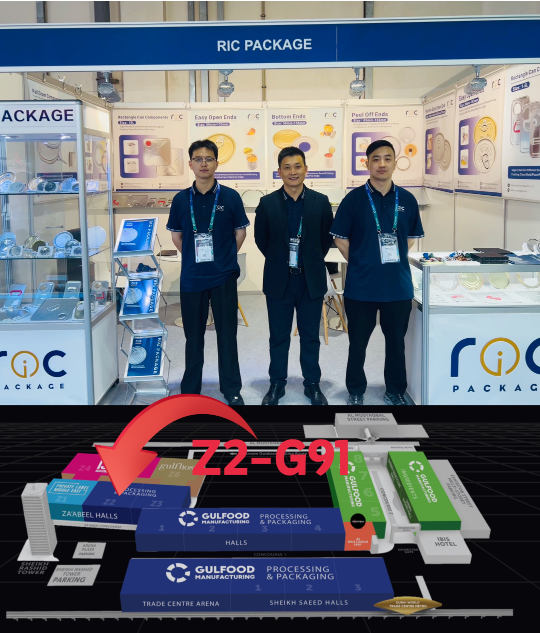
RIC PACKAGE Solutions for Metal Packaging Components
RIC PACKAGE is committed to providing professional tinplate can ends and metal packaging component solutions. Whether you require standard products or customized designs, we can offer solutions tailored to your production needs. By sourcing can ends and related components from RIC PACKAGE, your business can benefit from the cost advantages of China’s competitive tinplate supply chain and strengthen the competitiveness of your products and brands.